 Ashely Gore

Have you ever spent hours studying without seeing the results you hoped for? I’ve been there too. The key to effective studying isn’t just the time you spend but how you study. Developing a routine can turn studying into an almost automatic process, making your efforts more productive. It’s like going to the gym, you just have to go first then eventually you’ll get in the mood to workout based on the atmosphere. Studying is the same, you just have to show up every day, then that will set up the mood.
One influential approach comes from a book I’ve read before, Cal Newport’s Deep Work. Newport advocates for deep, focused work, suggesting that eliminating distractions and scheduling specific blocks of time for intense concentration can dramatically improve productivity.
Here are some other proven study techniques and their origins:
Active Recall
This is when you attempt to retrieve information from memory without looking at notes or textbooks. This technique forces your brain to actively engage with the material, rather than passively reviewing it. When you try to recall information (e.g., through quizzes or writing summaries), it strengthens your memory connections. The effort to recall, even if you fail, boosts learning because it triggers cognitive processes that enhance retention. Studies by cognitive psychologists like Henry Roediger and Jeffrey Butler show that active recall is more efficient than passive study methods (like reading or highlighting), significantly improving retention and understanding.
Spaced Repetition
This is when information is reviewed over increasing intervals (e.g., reviewing a topic after one day, then three days, then a week, etc.) This technique leverages the brain’s tendency to forget over time, as demonstrated by Hermann Ebbinghaus’s forgetting curve. Spacing out reviews interrupts forgetting, strengthening memory retention at each interval. With each review session, the information becomes more ingrained. Spaced repetition combats the natural decline in memory retention and reinforces long-term recall by repeatedly activating memory retrieval.
Pomodoro Technique
This is when you study in short, intense bursts (usually 25 minutes, known as a “Pomodoro”), followed by a 5-minute break. After four intervals, you take a longer break. During the focused interval, your mind stays engaged without distractions, and the short breaks prevent cognitive overload. This balance of work and rest increases productivity and prevents burnout. This study technique was created by Francesco Cirillo, this method capitalizes on human attention spans, maintaining high focus during study periods and allowing relaxation, which ultimately enhances efficiency.
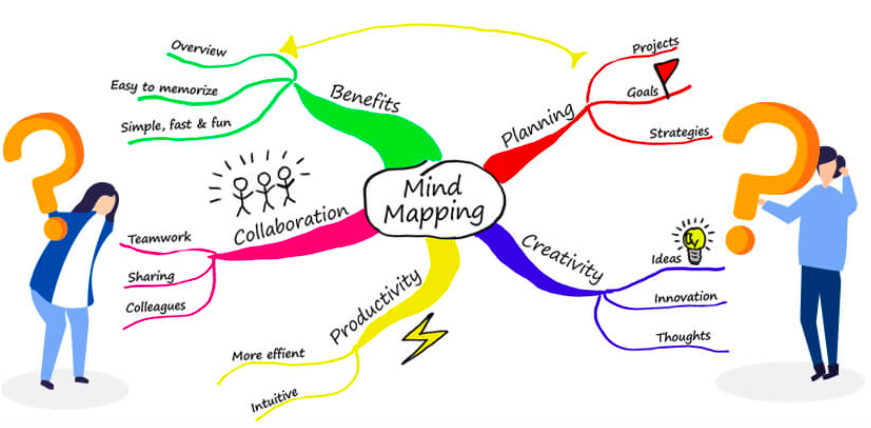
Mind Mapping
For this study technique you create a visual diagram that organizes information hierarchically, using branches to represent relationships between ideas. Mind maps provide a visual representation of concepts, which taps into the brain’s visual memory system. The non-linear structure helps to associate different ideas more effectively and promotes deeper understanding by visually linking concepts.Tony Buzan popularized this method to help learners visualize connections between topics, improving both comprehension and recall, especially for complex subjects. Recently, I found out there are different types of visual diagrams such as fishbone diagrams, not just mindmaps.
Feynman Technique
For this technique you attempt to explain a concept in simple terms, as if teaching it to someone who doesn’t know anything about the topic. This is probably my favourite, playing pretend teacher. This technique reveals gaps in your understanding because if you can’t explain the material simply, it indicates you don’t fully grasp it. Simplifying forces you to distill key concepts, ensuring that you process and internalize the information more deeply. Named after physicist Richard Feynman, this technique improves both comprehension and retention by making sure you engage with the material critically, ensuring true understanding.
Dual Coding
You learn through both verbal and visual means simultaneously, like pairing a diagram with descriptive text. By presenting information in both visual and verbal formats, your brain processes the material in two ways. These dual pathways strengthen your ability to recall and understand the information, as it’s stored in two different formats. This will trigger your memory easily in an exam. Allan Paivio’s research demonstrated that combining visual and verbal learning improves cognitive processing and retention, particularly for subjects requiring complex understanding, like science and math.
Self-Explanation
During study sessions, you pause and explain what you’ve learned to yourself, either out loud or in writing. I used to confuse it with the Feyman technique. This process encourages you to process the information more deeply by making connections between ideas and highlighting what you don’t yet fully understand. By articulating concepts in your own words, you make the learning more meaningful and personalized. Educational psychologists, such as Michelene Chi, found that self-explanation promotes metacognition (thinking about thinking), which leads to greater learning gains and identifies misconceptions you might not realize.
Interleaved Practice
Instead of studying one topic in depth, you mix different topics or subjects within a study session. Interleaving makes your brain work harder to differentiate between concepts. By switching between topics, it reinforces connections between them and strengthens your ability to apply what you’ve learned in diverse situations. This method encourages flexibility in thinking and application of knowledge across different contexts. Studies by psychologists Robert and Elizabeth Bjork show that this technique improves problem-solving skills and long-term retention, even though it may feel more challenging and less productive than blocked practice (focusing on one topic at a time).
There’s a quote that motivates me by Albert Einstein that says, “It’s not that I’m so smart, it’s just that I stay with problems longer.” This highlights the importance of persistence and strategic study techniques. By implementing these methods into your routine, you can turn your study hours into more effective and meaningful learning experiences.
By Tafadzwa Ashely Gore
Instagram: ashely_gore_ / Twitter: @gore_ashely
True Star Media’s content is made possible thanks to donors like you. By donating at truestarmedia.org/donate you are helping to empower young creators and transform lives.